
The pressure on developers from rising construction costs, labor shortages, compressed schedules, and financing risks has never been greater. This current reality is forcing project teams to rethink traditional building methods.
As a result, more developers are turning to design-build mass timber strategies and prefabricated timber construction to improve project certainty from concept through completion, among many other benefits.
Rather than viewing mass timber solely as a sustainable alternative to steel or concrete, today's savvy teams are recognizing it as a way to simplify coordination, reduce risk, and accelerate project delivery.
Why Developers Are Looking Beyond Traditional Construction
Every day a project spends under construction represents additional carrying costs, labor expenses, and exposure to unforeseen delays.
Traditional construction methods often involve multiple trades working sequentially on-site, increasing the potential for schedule conflicts, rework, and budget overruns.
Prefabricated mass timber changes that equation.
By manufacturing structural components in a controlled facility before they arrive on-site, project teams can begin foundation work while timber panels are simultaneously being fabricated. Once delivered, components arrive ready for installation, significantly reducing field labor and construction duration.
For developers, that means earlier occupancy, faster revenue generation, reduced financing costs, and greater confidence in project timelines.
What Is Prefabricated Timber Construction?
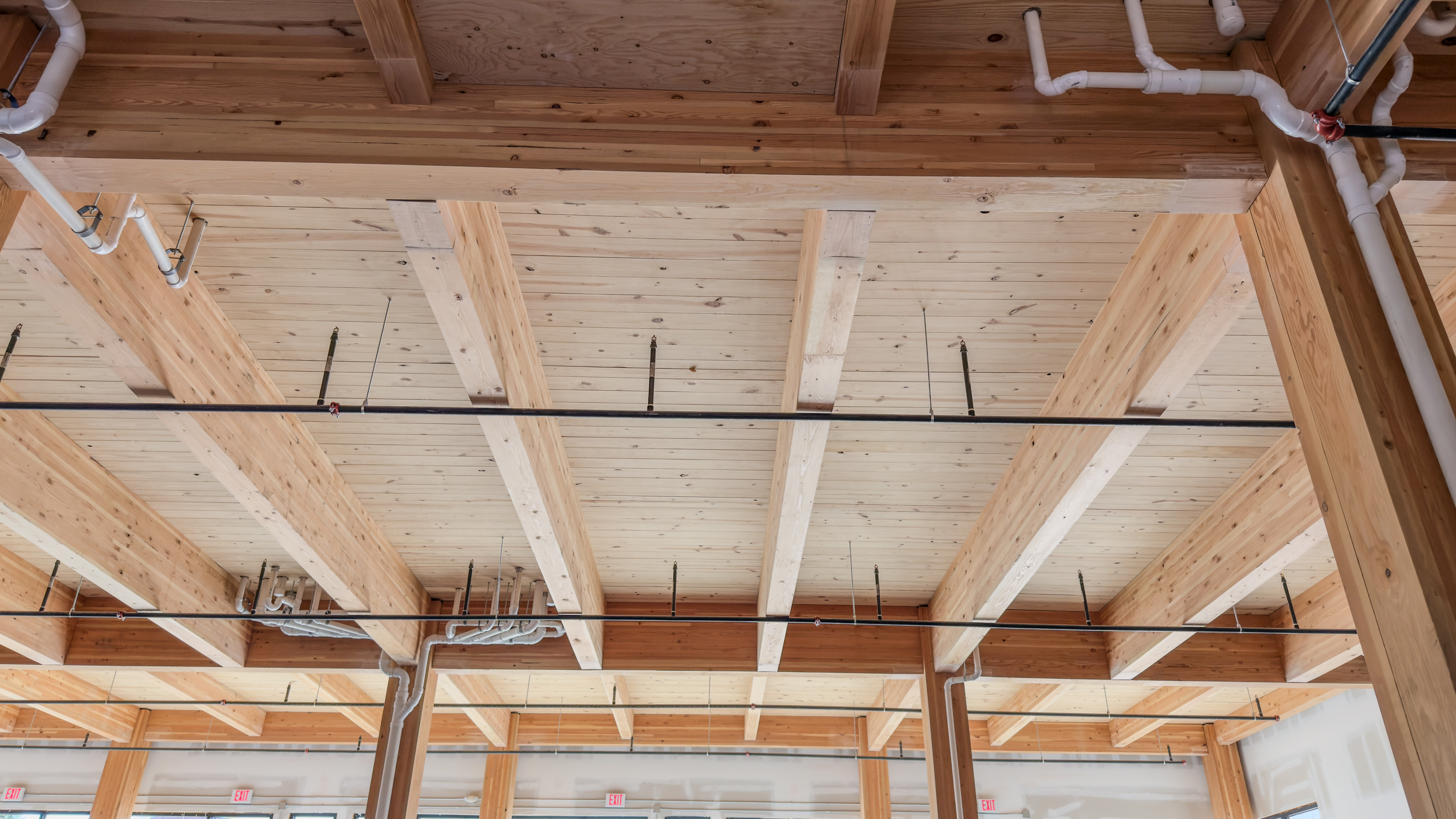
Prefabricated timber construction involves manufacturing engineered wood components, such as cross-laminated timber (CLT) panels and glulam beams at a manufacturing plant using advanced CNC (Computer Numerical Control) technology.
Each element is produced to precise specifications, including openings for doors, windows, mechanical systems, and connection details.
When delivered to the jobsite, these components are installed like a kit of parts, minimizing waste and reducing the need for extensive on-site modifications.
The result is a highly coordinated construction process that supports both speed and quality.
The Design-Build Advantage
The design-build mass timber approach creates opportunities for collaboration much earlier in the project lifecycle.
Instead of design and construction teams operating independently, architects, engineers, contractors, and manufacturers work together from the beginning to optimize the building system.
This integrated process helps:
- Resolve constructability issues before fabrication begins.
- Improve coordination between structural and MEP systems.
- Reduce redesign and change orders.
- Streamline procurement and scheduling.
- Improve communication among all stakeholders.
When mass timber suppliers are engaged early, they can also provide valuable design assistance that helps optimize panel layouts, connection strategies, and manufacturing efficiencies.
How CLT Improves Cost Certainty
One of the biggest concerns for developers today is cost volatility.
The CLT design-build advantages extend beyond faster installation, they also provide greater predictability throughout the project.
Factory-controlled manufacturing reduces material waste and minimizes the likelihood of costly field modifications. Because panels are produced to exact dimensions before shipment, many coordination issues are identified long before crews arrive on-site.
In addition, shorter construction schedules can reduce financing costs, site overhead, and weather-related delays.
This level of certainty allows developers to plan more confidently and better manage project budgets.
Understanding Mass Timber Cost Savings
While comparing material costs alone may not always show an immediate advantage, evaluating the project as a whole often reveals significant mass timber cost savings.
Potential savings can come from:
- Reduced construction schedules.
- Lower on-site labor requirements.
- Fewer trade conflicts.
- Minimized material waste.
- Reduced equipment time.
- Earlier project occupancy.
- Lower financing and carrying costs.
For many projects, these indirect savings offset the higher direct material costs, and potentially reduce overall costs.
Better Collaboration Through Digital Coordination
Modern mass timber manufacturing relies heavily on digital modeling and Building Information Modeling (BIM).
Detailed coordination occurs before fabrication begins, allowing architects, engineers, fabricators, and contractors to identify conflicts virtually instead of discovering them during construction.
This proactive approach reduces surprises on-site and helps projects stay aligned with both schedule and budget objectives.
The result is a smoother construction process and fewer costly disruptions.
Supporting a Wide Range of Building Types
Prefabricated mass timber is no longer limited to office buildings or specialty projects.
Today, developers are successfully applying these systems across:
- Multifamily Housing
- Hospitality
- Student housing
- Commercial offices
- Industrial facilities
- Data centers
- Institutional buildings
- Mixed-use developments
As manufacturing capabilities continue to expand, standardized prefabricated systems are making mass timber more accessible for projects of all sizes.
Building Smarter with Sterling Structural
At Sterling Structural, we believe successful projects begin long before construction starts.
Our team works alongside developers, architects, engineers, and contractors to deliver prefabricated mass timber solutions that improve coordination, reduce uncertainty, and support efficient project delivery.
From early design assistance through manufacturing and logistics, we help project teams leverage the benefits of design-build mass timber while maximizing the advantages of prefabricated timber construction.
Whether you're evaluating CLT for multifamily housing, hospitality, industrial facilities, or innovative structural systems, early collaboration can unlock meaningful schedule improvements and long-term value.
Developers today need solutions that provide more than sustainability, they need predictability.
By embracing design-build mass timber, teams can improve collaboration, increase cost certainty, shorten schedules, and create a more streamlined construction process.
As the industry continues to evolve, prefabricated mass timber is proving that smarter building starts with smarter planning.