
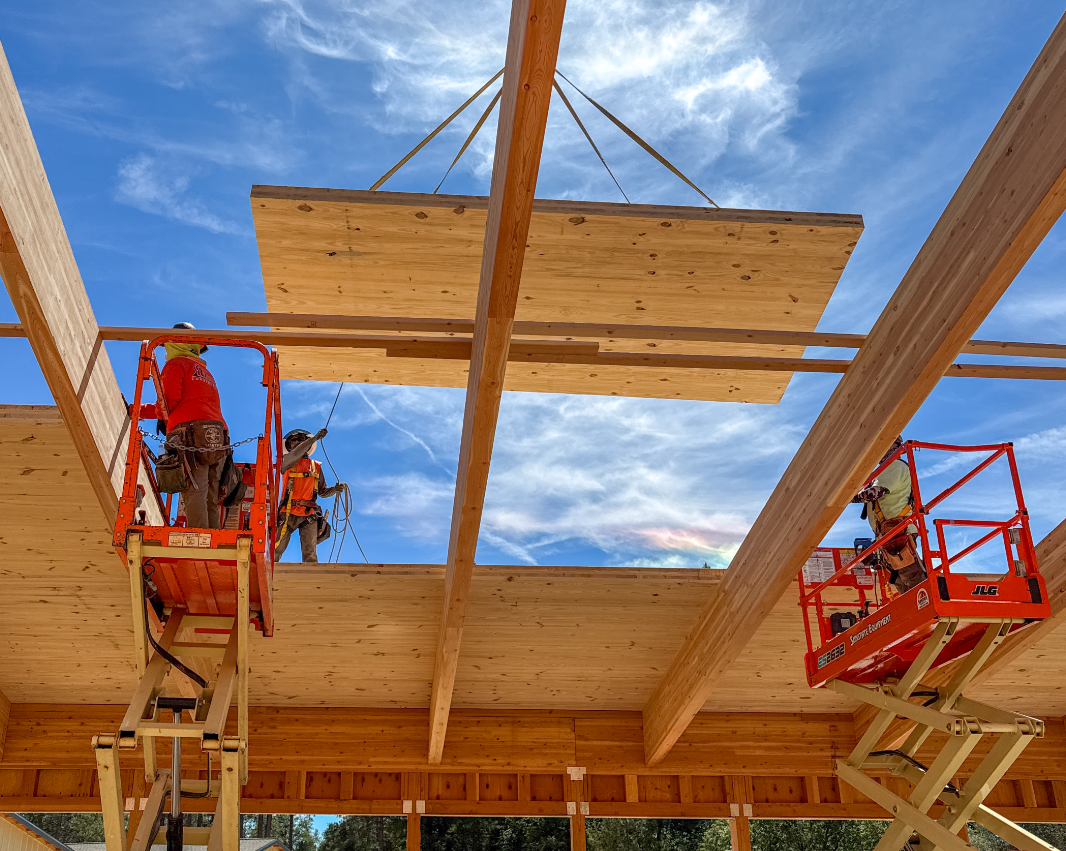
Cross-laminated Timber (CLT) installation speed, prefabrication, and early coordination are changing how project teams approach construction schedules. Here's why mass timber can make a measurable difference.
In construction, time is more than a scheduling consideration. It directly affects labor costs, financing, resource allocation, and how quickly a building can become operational.
As project teams face increasing pressure to deliver faster without compromising quality, material selection is becoming an important part of the scheduling conversation.
CLT panels offer an opportunity to rethink how buildings are designed, manufactured, and assembled. Rather than relying on traditional construction sequences that require extensive onsite fabrication, mass timber introduces a manufacturing-led approach that can simplify installation and reduce construction time.
But the real advantage goes beyond how quickly a CLT panel can be installed.
The greatest mass timber schedule advantages come from not only reducing the number of activities required on the critical path but also making those activities more predictable.
Understanding the Critical Path in Construction
Every construction project has a sequence of activities that determines its minimum completion time. Known as the critical path, these are the tasks that must be completed on schedule to prevent delays to the overall project.
Traditional construction methods often involve multiple dependent activities, including material deliveries, onsite forming, reinforcement, concrete placement, curing, inspections, labor availability, and follow-on trades.
When one activity is delayed, subsequent work may also be affected.
Mass timber creates opportunities to streamline this process by moving a significant portion of the work into a controlled manufacturing environment, in effect reducing the number of activities at risk of delay or disruption.
CLT panels are fabricated to project-specific dimensions, with openings and connection details “built-in” before arriving onsite. This allows construction teams to focus more on assembly and less on fabrication in the field.
The result is a more efficient construction sequence with fewer onsite variables.
1. CLT Installation Speed: Building Faster Through Prefabrication
One of the most immediate benefits of CLT is the speed at which prefabricated structural components can be assembled.
Unlike conventional methods that require substantial onsite forming, cutting, or fabrication, CLT panels arrive ready for installation according to a coordinated erection plan.
Using cranes and planned lifting sequences, installation crews can position and secure large structural panels efficiently.
This approach offers several potential scheduling benefits:
- Faster structural assembly: Large prefabricated panels can cover significant floor or roof areas with fewer individual installation operations.
- Reduced onsite fabrication: CNC-manufactured components minimize the need for extensive field cutting and modifications.
- Simplified material handling: Coordinated deliveries and installation sequences can reduce onsite congestion.
- Greater installation predictability: Repeatable components allow teams to establish consistent erection procedures and production rhythms.
CLT panel installation speed becomes particularly valuable on projects with repetitive structural layouts, where crews can build efficiency as installation progresses.
However, installation speed alone does not determine the overall project schedule. The greatest benefits occur when the structural system is coordinated with the building's other components early in design.
2. Reduce Construction Time by Moving Work Offsite
Traditional construction schedules often concentrate significant amounts of work at the jobsite, where activities compete for space, equipment, labor, and favorable weather conditions.
Prefabricated CLT panel change this dynamic.
Through prefabrication, many manufacturing activities can occur while site preparation and foundation work are underway.
This creates opportunities for parallel workflows rather than requiring every activity to happen sequentially.
For example, while the project team prepares the site, CLT panels can be manufactured, processed, and organized for delivery based on the installation schedule.
Once the site is ready, prefabricated components can be delivered in planned sequences for assembly.
This approach can help reduce construction time by:
- Minimizing onsite material processing and fabrication.
- Reducing dependencies between certain construction activities.
- Improving coordination between manufacturing and field operations.
- Supporting more predictable labor and equipment planning, including reducing the number of different trades on site.
- Limiting some weather-related exposure associated with onsite structural work.
Importantly, offsite manufacturing does not eliminate scheduling risks. Manufacturing capacity, design approvals, procurement lead times, transportation, and site readiness must all be considered.
The key is integrating manufacturing into the construction schedule from the beginning rather than treating it as a separate procurement activity.
3. Repeatable Systems Create More Predictable Schedules
Not every mass timber project delivers the same schedule benefits. Highly customized structural systems can introduce additional engineering, detailing, fabrication, and coordination requirements.
Standardization and repeatability help address these challenges.
By using consistent panel dimensions, connection strategies, and assembly methods, project teams can reduce unnecessary complexity across design, manufacturing, and installation.
Repeatable systems can also support more reliable estimating, production planning, and installation sequencing.
For developers and contractors working on industrial, commercial, hospitality, or other building types with repetitive layouts, this approach can be particularly valuable.
At Sterling Structural, we focus on making mass timber more accessible through standardized, manufacturing-driven solutions.
Our approach combines CLT manufacturing capabilities, CNC precision, and early project coordination to help teams evaluate where repeatable mass timber systems can create practical construction efficiencies.
The goal isn't simply to manufacture panels faster. It's to make the entire process, from design through installation more efficient and predictable.
4. Early Coordination Protects the Critical Path
One of the most important factors in achieving mass timber schedule advantages happens long before the first panel reaches the jobsite. It starts with early engagement.
Mass timber requires coordination between architects, structural engineers, manufacturers, contractors, and installation teams.
Decisions about structural grids, panel dimensions, penetrations, connections, lifting strategies, and delivery sequences all influence the efficiency of the construction process.
When these decisions are addressed early, teams can identify potential challenges before they become costly field issues.
Bringing the manufacturer into the process too late can create unnecessary redesign, fabrication adjustments, or procurement delays.
Early manufacturer involvement supports:
- Design for Manufacturing and Assembly (DfMA)
- Coordinated fabrication details
- Installation and logistics planning
- More reliable procurement schedules
Aligning design decisions with manufacturing capabilities and installation requirements can reduce complexity and improve constructability.
Resolving openings, penetrations, and connection requirements before production can help minimize field modifications.
Understanding crane access, delivery constraints, staging areas, and erection sequences helps align manufacturing with site operations.
Early coordination provides greater visibility into material requirements, production windows, and delivery milestones.
The earlier these considerations become part of the project conversation, the more opportunities teams have to protect the critical path.
5. Hybrid Construction: Using the Right Material to Accelerate Delivery
Mass timber does not need to replace every structural material to create schedule benefits.
In many projects, the most effective solution is hybrid and combines CLT with steel, concrete, or other building systems.
Hybrid construction allows project teams to select materials based on structural performance, constructability, cost, and scheduling priorities.
For example, CLT floor or roof panels may be integrated with steel framing, while other building components use conventional systems.
This flexibility allows teams to target mass timber where prefabrication and rapid assembly offer the greatest value.
When properly coordinated, hybrid construction can help streamline specific installation activities while maintaining the flexibility required for complex projects.
6. Schedule Efficiency Beyond Structural Installation
The benefits of faster structural assembly can extend beyond the immediate installation phase.
When structural work progresses efficiently, subsequent trades may gain earlier access to designated work areas, depending on the project's sequencing and safety requirements.
This can create opportunities to advance building enclosure, mechanical and electrical installations, and interior construction activities.
Mass timber also offers the potential to reduce some onsite material handling and construction waste because components are fabricated to specified dimensions before delivery.
For general contractors, these efficiencies can contribute to improved site organization, reduced dependency on weather, and more predictable workflows.
For developers and owners, a shorter overall construction schedule may help reduce certain project carrying costs and accelerate occupancy or operational readiness.
However, these benefits depend on the complete project schedule. Faster structural installation only translates into earlier completion when it shortens activities that control the project's critical path.
That distinction is essential when evaluating mass timber against other structural systems.
The Sterling Structural Approach: Speed Starts Before Installation
At Sterling Structural, we believe the greatest value of mass timber comes from understanding how it fits into the entire construction process.
Our manufacturing-driven approach emphasizes early engagement, repeatable systems, and collaboration across design, engineering, fabrication, and installation planning.
By helping project teams evaluate constructability and manufacturing requirements early, we work to identify opportunities to simplify assemblies, improve coordination, and support efficient project delivery.
Our experience supplying CLT panels for projects ranging from industrial facilities to multi-story hospitality buildings demonstrates the versatility of mass timber across different construction applications.
Whether a project uses a predominantly mass timber structure or a hybrid solution, our focus remains the same: helping teams make informed decisions about where prefabricated structural systems can provide meaningful value.
Let's Talk About Your Next Project
Looking for ways to improve your construction schedule?
Sterling Structural can help your team explore how prefabricated CLT and hybrid structural systems may support faster, more predictable project delivery.
Connect with Sterling Structural to discuss your project.